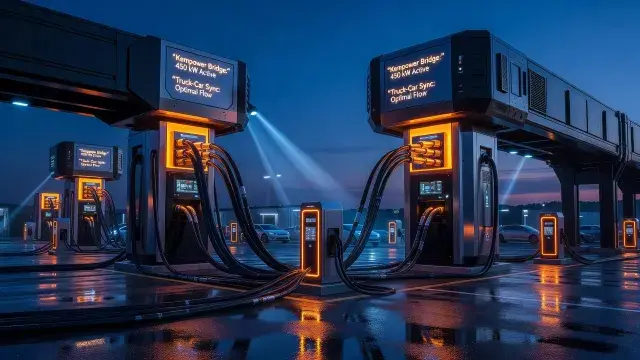
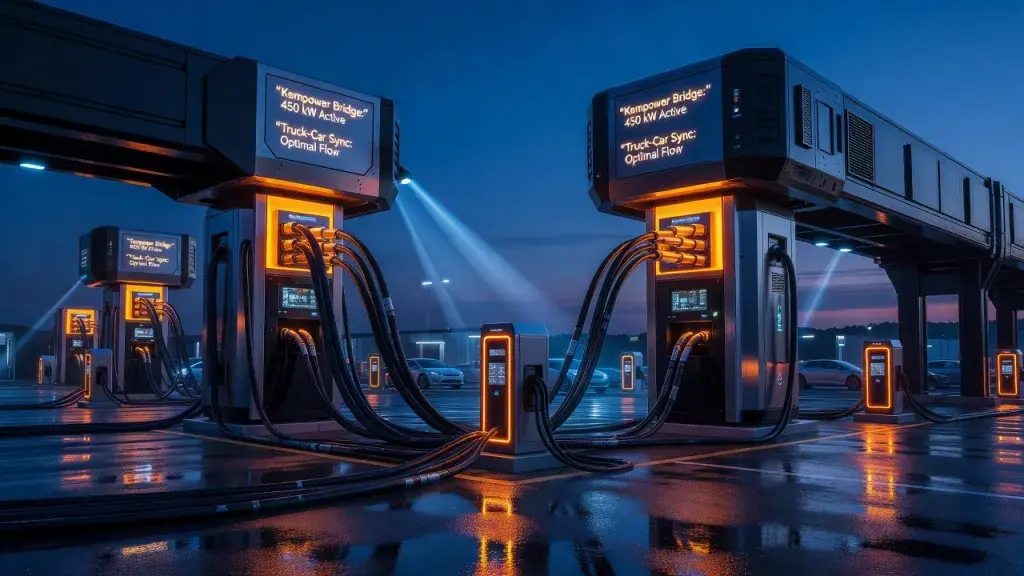
Kempower has introduced a charging unit designed to serve both electric cars and heavy-duty trucks from the same piece of hardware, a move that could reshape how charging sites are planned in the coming years. The Mega Satellite Flex supports the established CCS standard at up to 560 kW alongside the emerging Megawatt Charging System (MCS) at up to 1.2 MW, making it the company's first dispenser capable of switching between the two. It was revealed this week at the Unplug & Recharge event held during ACT Expo.
Why One Charger for Two Vehicle Classes Matters
Charging infrastructure has historically split along vehicle type. Passenger EVs rely on CCS, a connector standard that has become the default across North America and Europe over the past decade. Heavy-duty trucks, however, need far more power to make sense economically, since long routes and tight delivery schedules leave little room for lengthy stops. That is where MCS comes in: it is engineered specifically for commercial vehicles that need to add hundreds of kilowatts in the time it takes a driver to take a mandated break. Building separate stations for each standard has been the norm, which means duplicated land, wiring, and permitting costs. Site operators evaluating equipment options, including through resources like reference, are increasingly aware that flexibility in hardware can determine whether a charging site is profitable within a reasonable timeframe.
Technical Specifications and What They Enable
The Mega Satellite Flex is built to handle demanding electrical loads. It supports up to 1,500 amps on the MCS side and 700 amps for CCS, figures that reflect the very different power profiles of trucks versus cars. Cable lengths matter too: the unit ships with a 5-meter (16.4-foot) cable for CCS and a shorter 2.7-meter (8.86-foot) cable for MCS, dimensions suited to each connector's typical vehicle geometry. An optional payment terminal allows the charger to function as a standalone commercial unit rather than requiring a separate kiosk.
- CCS charging: up to 560 kW, 700 amps, 5-meter cable
- MCS charging: up to 1.2 MW, 1,500 amps, 2.7-meter cable
- Compatible with 800-volt EV architectures for faster charging
- Integrates with Kempower's existing distributed charging systems
A Transition Strategy, Not Just a Product Launch
The timing reflects where the market actually stands. CCS remains dominant for passenger vehicles, while MCS infrastructure is only beginning to appear at scale for trucking corridors. Rather than betting entirely on one standard, Kempower is offering operators a way to serve both markets from a single installation, deferring the decision about which standard will dominate a given site until demand becomes clearer. Compatibility with 800-volt EV platforms adds another layer of future-proofing, since newer vehicle architectures are designed to draw higher currents safely, cutting charging times further. For fleet operators and charging network builders, the promise is straightforward: higher utilization per site, reduced need for a second buildout later, and a faster path to recovering capital costs. The Mega Satellite Flex is expected to reach North American and European markets in July 2026, giving operators time to plan installations around the product's arrival.