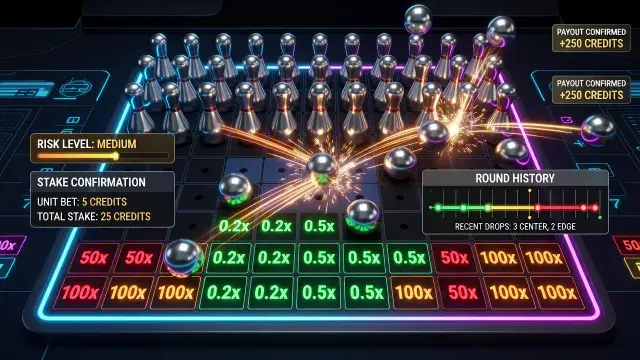

A single round can flip from a modest wager to a payout worth dozens of times the stake in under ten seconds. That kind of compressed volatility is exactly why fast, physics-driven ball games have carved out a stubborn following among players who want quick decisions and quicker feedback. Crazy Balls belongs to that category - a title built on visible randomness, simple mechanics, and outcomes that reward pattern recognition as much as luck.
Most newcomers approach it the wrong way: they place a bet, watch the ball bounce, and treat every result as pure chance without ever learning the underlying crazy ball rules that shape payout structure and risk. That's a mistake. Understanding the mechanics before committing real money changes how you read each round. Players who want a fast overview before testing the mechanics themselves can head next to see the live format in action, though the fundamentals below are worth absorbing first. What follows is a full breakdown of setup, gameplay flow, and the strategic thinking that separates disciplined players from those who bet on impulse.
What Is Crazy Balls and Why Players Are Drawn to It
Crazy Balls is a chance-based game built around a drop mechanic: a ball falls through a field of pegs, obstacles, or numbered slots, and where it lands determines the payout multiplier. The appeal isn't complexity - it's the opposite. The format is visually simple enough to grasp in one round, yet the physics of the drop create enough variance that no two outcomes feel identical.
Origins and Popularity of Ball-Drop Formats
Ball-drop mechanics trace back to arcade and carnival games, where a coin or ball dropped through pins to land in a scoring slot. Online platforms adapted this physical concept into a digital wagering format, replacing coin machines with randomized digital physics engines. The transition kept the core appeal intact: visible, unpredictable motion that players can watch unfold in real time rather than trusting an abstract number generator alone.
Why This Game Appeals to Casual and Strategic Players Alike
Casual players like the short round length and the visual satisfaction of watching a ball bounce toward a high-value slot. Strategic players, meanwhile, focus on the mathematical structure behind the slots - the distribution of multipliers, the frequency of low versus high payouts, and how bet sizing interacts with that distribution. Both groups can coexist in the same game because the crazy balls gameplay rewards attention without punishing casual engagement.
Crazy Balls Game Rules Explained
Before placing a single bet, it helps to understand the full rule set that governs how a round begins, plays out, and resolves. The crazy balls game rules are not complicated, but missing a detail - like how ties or edge-drops are handled - can lead to confusion about why a round paid out less than expected.
Basic Setup and Objective
The objective is straightforward: predict, influence, or simply benefit from where the ball lands after it's released. Each slot at the bottom of the board carries a fixed multiplier, and the ball's landing position determines your payout relative to your stake. There's no scoring against an opponent - you're playing against the board's payout structure itself.
Board Layout and Multiplier Zones
The board is typically arranged with lower multipliers clustered near the center and higher, riskier multipliers positioned toward the outer edges. This layout mirrors probability distribution - a ball dropped from the center has more paths converging toward the middle, making center landings statistically more common. Edge landings are rarer and pay out significantly more as a result.
Standard Crazy Ball Rules for Bet Placement
Bets are placed before the round starts, and most versions allow you to set the stake amount and sometimes the drop position. Once the round begins, no further adjustments are possible. This is a core part of the crazy ball rules that new players often overlook - the decision window closes the moment the ball is released, so any strategic thinking has to happen beforehand.
- Stake selection occurs before the drop, not during it
- Multiplier values are fixed and displayed on the board prior to each round
- Payouts are calculated instantly based on final slot position
- Round history is usually visible, allowing pattern review
Step-by-Step Crazy Balls Instructions
Following a clear sequence prevents the kind of rushed betting that leads to unnecessary losses. These crazy balls instructions apply broadly across most versions of the game, whether played casually or with a structured betting plan.
Setting Up Your First Round
Start by reviewing the board's multiplier layout and confirming your stake amount. Many platforms let you adjust risk level, which changes how multipliers are distributed across the board - higher risk settings push more value toward the edges while lowering payouts in the center. Choose a risk level that matches your bankroll tolerance before your first drop.
Understanding Drop Mechanics
Once you confirm your bet, the ball drops through the peg field and bounces according to a physics simulation. The path is not predetermined by anything visible to the player - it reacts to each peg collision independently. Watching several rounds before betting heavily gives you a feel for how volatile the board's physics tend to be.
Reading Payout Confirmation
After the ball settles, the platform confirms your payout instantly based on the slot multiplier. Review this confirmation carefully, especially if you're running multiple bets in sequence, since tracking net results across rounds matters more than any single outcome.
Crazy Balls Gameplay Walkthrough
Gameplay unfolds in short, repeatable cycles, which makes it easy to test different approaches over many rounds without a large time investment. Understanding the full cycle helps you recognize where decisions actually matter versus where the outcome is out of your hands.
The Full Round Cycle From Bet to Payout
Each round follows the same structure: stake confirmation, ball release, physics-driven descent, slot landing, and payout calculation. The entire cycle usually completes in a few seconds, which is part of why the game feels fast-paced compared to slower table-style formats.
Risk Settings and Their Effect on Outcomes
Most versions offer adjustable risk levels - often labeled low, medium, and high. Low risk spreads payouts more evenly across the board with modest multipliers throughout. High risk concentrates value at the extremes, meaning most rounds pay little or nothing, but occasional edge landings can multiply the stake substantially. This setting is one of the few genuine points of control within the crazy balls gameplay loop.
Multi-Ball and Rapid-Fire Variations
Some platforms allow multiple simultaneous drops or rapid consecutive rounds. This increases the volume of data you generate about the board's behavior but also increases exposure to variance faster. Treat these variations as an intensified version of the standard format, not a separate game with different underlying math.
Crazy Balls Strategy for Consistent Play
No strategy eliminates the randomness built into the physics engine, but disciplined approaches to bankroll management and risk selection measurably improve how long your funds last and how smoothly your results trend over time. A sound crazy balls strategy focuses on control over the variables you actually influence.
Bankroll Management Fundamentals
Set a fixed session budget before you start and divide it into unit bets rather than wagering large portions on single rounds. This approach absorbs the natural swings of a randomized payout system without risking your entire bankroll on one unlucky drop.
Choosing Risk Levels Based on Session Goals
If your goal is extended playtime with modest, steady returns, low or medium risk settings suit that objective better than high-risk boards, which are built for occasional large payouts amid frequent small losses. Match your risk setting to what you actually want from the session, not to what feels exciting in the moment.
Tracking Patterns Without Overtrusting Them
Reviewing round history can reveal short-term clustering - several center landings in a row, for instance - but this doesn't indicate a predictable trend. Each drop remains statistically independent. Use pattern tracking to inform pacing and confidence, not to justify chasing a "due" outcome.
Common Mistakes to Avoid
Even players who understand the crazy balls game rules thoroughly can undermine their results through avoidable behavioral errors. Recognizing these patterns early prevents unnecessary losses.
Chasing Losses After a Bad Streak
Increasing bet size specifically to recover a previous loss ignores the fact that each round is independent. This behavior often accelerates losses rather than reversing them.
Ignoring Risk Setting Consequences
Switching to high risk mid-session without adjusting bankroll expectations leads to faster depletion of funds, since high-risk boards produce far more empty rounds between payouts.
Playing Without a Predefined Budget
Entering a session without a stop-loss point removes the discipline that keeps short-term variance from becoming a long-term financial problem.
Frequently Asked Questions
Is Crazy Balls purely luck-based, or does skill play a role?
The core outcome - where the ball lands - is governed by randomized physics, so no amount of skill changes an individual drop. Skill enters through bankroll management, risk-level selection, and pacing decisions that shape long-term results across many rounds.
What's the difference between low and high risk settings?
Low risk spreads multipliers more evenly across the board, producing frequent modest payouts. High risk concentrates large multipliers at the board's edges, meaning most rounds pay little while rare edge landings produce substantial returns.
Can I influence where the ball lands?
In most versions, no. Once the ball is released, its path is determined by the physics engine's collision calculations, which operate independently of player input during the drop itself.
How much should I bet per round as a beginner?
Start with small unit bets, typically a fraction of your total session budget, so a handful of unlucky rounds doesn't exhaust your funds before you've had a chance to observe the board's behavior.
Does round history predict future outcomes?
No. Each drop is statistically independent of previous rounds. Round history is useful for understanding volatility patterns but shouldn't be treated as a forecasting tool.
Are multi-ball rounds a better strategy than single drops?
Multi-ball rounds increase the pace of play and the volume of outcomes but don't change the underlying probability structure. They suit players who want faster sessions, not players looking for better odds.